
Why Creative Professionals Matter Even More in a World of Generative AI

For decades, the creative industry was protected by a layer of friction, surrounded by a wall of honed skill. If you wanted to build a website, you had to master the syntax of the front-end. If you wanted to create cinematic video, you had to understand the physical characteristics of light, glass, and chemistry. The difficulty of the execution was often the gatekeeper of the profession.
Generative AI has effectively removed the friction. Today, the barrier to entry has vanished, and anyone can generate a professional-grade result in seconds. But if you think that makes the creative professional obsolete, you’re looking at the wrong side of the canvas.
Generative AI isn't a threat. It’s a call to action.
The “Peter Andrews” Edge
To understand where we are going, we have to look at how a master uses technical knowledge and skill to serve a vision. Think about Steven Soderbergh’s work on the 2000 film “Traffic.” Soderbergh, acting as his own cinematographer under the pseudonym Peter Andrews, used technical specifications as narrative weapons.
He famously used three distinct visual languages: the tobacco-stained, blown-out grain of Mexico; the cold, medicinal blue of Ohio; and the lush, saturated glow of San Diego. These were precise technical choices: specific film stocks, Ektachrome (purposely pushed) for Mexico, and deliberate practical lighting design that functioned as characters in the film.

An AI can give you a blue tint in seconds. But it doesn't have the lived experience to know why that blue needs to feel sterile, or how a specific aperture choice impacts the loneliness of a frame. The foundational skill is just the starting line; the experience of building, critiquing, and refining those choices is what creates the resonance.
Beyond the Prompt: The Power of Prescriptive Logic
I recently had a “lightbulb” moment while experimenting with Claude Code. I wanted to build a website, and while the AI did the heavy lifting, my history as a front-end developer changed the entire nature of the interaction.
I wasn't just prompting and hoping for the best. Because I understand the logic of code and have facility with the language of composition and design, I could be prescriptive. I could refine the architecture, critique the logic, and push the output further because I knew exactly what a “finished” product should look like.
The AI wasn't replacing my skill; it was an exoskeleton granting me incredible superpowers. I was applying a career’s worth of critique to a machine that can execute, but cannot judge. The artisan who knows how a 50mm lens compresses a face or why a 4000K color temp feels “off” in a specific context is the one who will produce work that actually moves the needle.
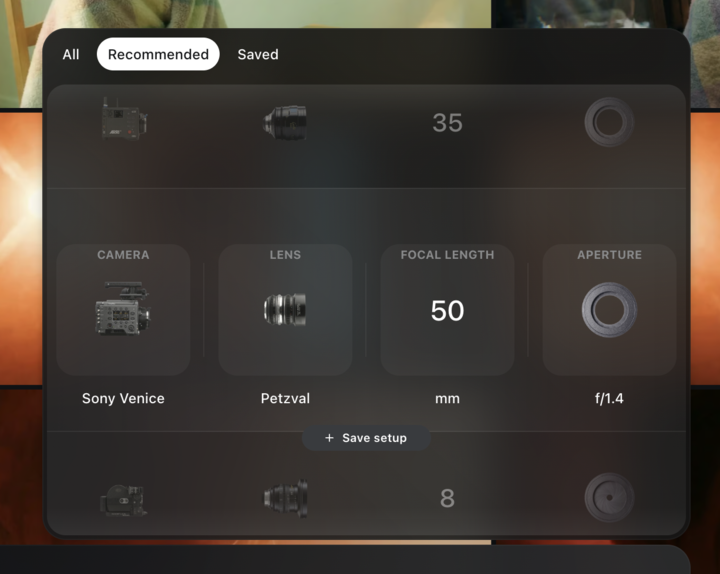
This lightbulb exploded when I was having a conversation with an industry friend experimenting with another tool (higgsfield.ai). He shared a project in which he was using the tool’s preset to select camera, lens, aperture, focal length, etc. to get more from the output he was generating and editing. Growing up in a grip and lighting house with a family in the film industry brought the idea for this article into new clarity. My friend, a film and motion designer, brought something unique to the machine – experience.
The Mastery of the Output
We have a habit of forgetting that the “old masters” were the ultimate technical innovators. They didn't fear the tool; they mastered the output.
Leonardo da Vinci was a scientist of light and shadow before he was a painter. He pioneered techniques like sfumato (the blurring of edges) because he critiqued the harsh, unrealistic lines of his contemporaries and engineered a better way to represent reality.
Johannes Vermeer didn't just have a gift for light; he was a pioneer of optical technology. Historians believe he used a camera obscura not as a shortcut, but as a technical tool to study the literal physics of light.
Ansel Adams didn't just take a photo of a mountain. He used his Zone System, a complex technical framework for pre-visualizing the final print, to map out exactly how the chemistry of the darkroom would interact with the light of the Sierras. Like the logic of a developer, Adams’ system allowed him to be prescriptive about the result before he even pressed the shutter.
Andy Warhol didn't see the Xerox machine as a threat to real art; he saw it as a tool to critique the very idea of mass production. He turned a commodity tool into a medium for high art by knowing exactly how to manipulate the output to make a statement.
He understood that as the making becomes easier, the act of refinement becomes a core value.
The New Creative Standard
We are entering an era where “good enough” is now free and instantaneous. If you are a creative professional who relies solely on the difficulty of your task to prove your value, the world is changing underneath you.
But if you are a creative who understands that your foundational skills (your developer’s logic, your cinematographer’s eye, your designer’s taste) are the tools you use to steer the machine, then your value has never been higher.
The technical barrier is gone, but the standard for what is great has never been higher. The tools have finally caught up to our imagination—now it's up to us to show them where to go.
Footnotes
- American Cinematographer. (2001). "The Multi-Hued World of Traffic." Details Soderbergh’s use of the Peter Andrews pseudonym and the specific technical film stocks (Ektachrome, 45-degree shutters) used for the film's three distinct color palettes.
- Anthropic. (2025). "Claude Code: Agentic CLI for Developers." A technical tool enabling prescriptive codebase interaction and high-speed architectural refinement.
- The Louvre Museum. "Technical Analysis of the Mona Lisa." Documentation on sfumato, a technique involving the application of multiple translucent layers of paint to eliminate sharp outlines.
- Steadman, P. (2001). Vermeer's Camera: Uncovering the Truth behind the Masterpieces. Oxford University Press. Evidence of Vermeer’s use of optical tools to achieve hyper-realistic light.
- Adams, A. (1981). The Negative. Little, Brown and Company. Detailed exposition of the Zone System, a systematic method for pre-visualizing and controlling photographic exposure and development.
- The Andy Warhol Museum. "The Warhol Xerox Prints." Records on how Warhol used photocopiers to manipulate high-contrast imagery and explore the intersection of art and mass production