The Most Valuable Thing AI is Exposing Isn't People. It’s Process.

A few weeks ago, my husband said something that I haven't been able to stop thinking about:
“AI isn’t exposing people. It’s exposing traditional workflows.”
This perspective highlights a shift that many businesses are just starting to recognize. As AI is woven into the organizational fabric, the primary consequence isn’t simply automation or the displacement of roles. Rather, it’s a necessary confrontation with the legacy workflows and structural assumptions that have been long established.
For decades, businesses designed workflows around the limitations of available technology. Advertising may be one of the clearest examples. As channels, platforms, audiences, and data sources multiplied, marketers built increasingly complex operating models to compensate for fragmentation. Teams were structured around disconnected systems, manual data movement, lengthy approval cycles, and operational dependencies that simply represented the cost of getting work done. Over time, these processes became embedded in the way organizations operated. They were no longer viewed as design choices; they became assumptions.
AI is now challenging many of those assumptions.
As organizations begin implementing AI, many are discovering that the technology itself is not the most interesting part of the transformation. The more significant realization often comes when they examine workflows.
In this way, AI acts less as a replacement for work and more as a catalyst for rethinking how work is structured.
What makes this moment particularly interesting is that many of the processes being questioned were not poorly designed … they were designed for a different era. They evolved in response to technological constraints that no longer exist. The challenge organizations face today is determining which workflows still serve a purpose and which have simply persisted because they have become familiar– to elevate our thinking out of what we can do and into what we are trying to achieve.
Advertising provides a useful example.
Over the last decade, marketing organizations have built increasingly sophisticated operating models to manage a growing number of channels, platforms, audiences, creative assets, measurement frameworks, and optimization strategies. As complexity increased, so did the operational effort required to support it. Campaign trafficking, quality assurance, reporting, asset management, version control, and stakeholder coordination became essential functions within the advertising ecosystem.
These activities create value, but they are rarely the source of competitive advantage.
The marketers who drive the greatest business impact are typically distinguished by their ability to understand consumers, identify opportunities, develop strategy, solve problems, and make sound decisions. Yet many of those same individuals spend a significant portion of their time navigating operational processes that sit between an idea and its execution.
This is why I believe the most important AI conversation is increasingly about organizational capacity.
When organizations evaluate AI solely through the lens of automation, they risk overlooking a much larger opportunity. The more meaningful question is how AI can help reduce the operational burden surrounding work, allowing talented people to focus more of their time on activities that require human judgment, creativity, and expertise.
At the same time, AI is revealing another challenge that exists across many industries: the gap between insight and action.
Most organizations are not struggling to generate information. They have access to dashboards, reports, recommendations, predictive models, and performance data. The challenge is turning those insights into action consistently and efficiently.
In advertising, this gap is particularly visible. Recommendations are surfaced, opportunities are identified, and decisions are made, yet execution often requires coordination across multiple teams, systems, and workflows. Valuable time is spent moving information, validating decisions, and managing operational processes before any action occurs.
The result is that organizations often possess the intelligence required to improve performance long before they possess the operational capacity to act on it.
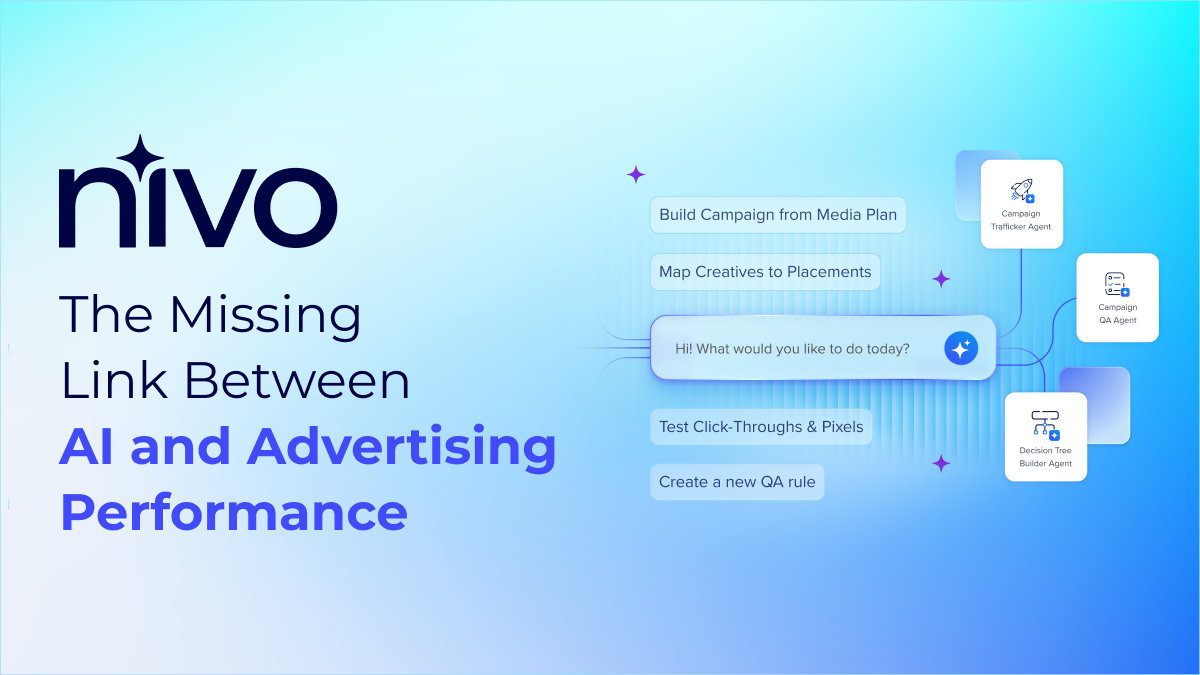
This belief has shaped how we think about NIVO at Innovid.
The opportunity we see is not simply to provide another source of intelligence. The industry already has an abundance of signals, insights, and recommendations. The larger opportunity is reducing the operational complexity that exists between a signal and a decision, and between a decision and an outcome.
That may ultimately be one of the most valuable contributions AI makes.
Not because it changes who performs the work, but because it creates an opportunity to rethink how the work should be structured in the first place. Human expertise in problem-solving, creativity, judgment, and relationship building remains irreplaceable. As innovation introduces new possibilities, humans move out of being execution specialists and more time shaping outcomes.
The organizations that benefit most from AI will likely be those that use it as more than an automation tool. They will use it as a catalyst to redesign workflows, remove friction, and unlock greater value from the people already inside their business.
In the end, the future of AI may have less to do with replacing human contribution and more to do with expanding it.